
Intentional Tedium (free post!)
middle earth monday (pt. 8)

“I hope that you have enjoyed The Lord of the Rings? *Enjoyed* is the key-word. For it was written to *amuse* (in the highest sense): to be readable. There is *no* 'allegory', moral, political or contemporary in the work at all. It is a 'fairy-story', but one written - according to the belief I once expressed in an extended essay 'On Fairy-stories' that they are the proper audience - for adults. Because I think that fairy story has its own node of reflecting 'truth', different from allegory, or (sustained) satire, or 'realism', and in some ways more powerful. But first of all it must succeed just as a tale, excite, please, and even on occasion move, and within its own imagined world be accorded (literary) belief. To succeed in that was my primary object.” J.R.R. Tolkien, Letter 181
Happy Middle-earth Monday!
You’ve made it to Many Meetings, the home of Tolkein-dom on Substack. This is where I send out weekly posts for us to gather around and discuss the works of The Professor. You’ll find the paywall has been removed from this week’s post to give you a peek into what my paid subscribers get from me every Monday.
Right now, we’re going through The Lord of the Rings as a group with more Tolkien read-throughs planned in 2026! You’re welcome to join us anytime you like. Everyone is reading at their own pace and joining in when and where they can.
In today’s post were discussing how (possible) influence from the Valar aided Frodo, the deep lore Gollum brings to the story and finally, my controversial take on why Movie Faramir is just as valid as Book Faramir and how his character is one Tolkien originally did not want at all.
Let’s get into it.
Where I’m at this week:
I’ve finished the chapters: The Taming of Sméagol, The Passage of the Marshes, The Black Gate is Closed, Of Herbs and Stewed Rabbit, The Window on the West and The Forbidden Pool.
Frodo and Sam have been forced to accept Gollum/Sméagol as their guide through the maze of Emyn Muil, the Dead Marshes and eventually to the Black Gate itself. There, they’ve realized, in a whole new way, just how desperate and seemingly futile their mission is. At the last possible second, Sméagol has revealed a secret path that he can take them on that might gain them access to the Black Land. Sam and Frodo are once again wholly put in the hands of the one who could betray them the most.
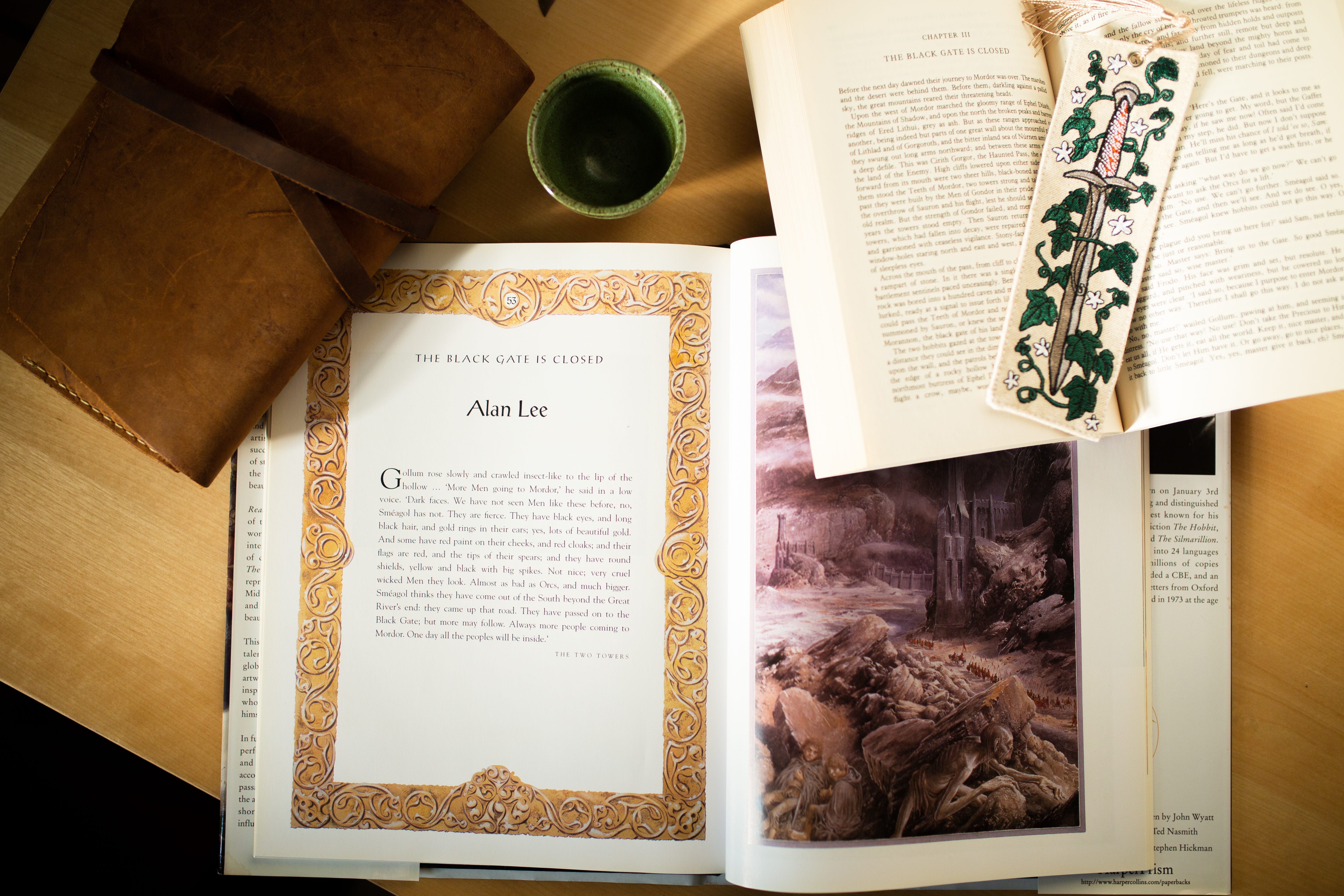
Thankfully, Sméagol’s guidance has temporarily led them through North Ithilien where–though it has become occupied by the servants of the Enemy– it still remembers the fair beauty it was once known for. Here, they’ve met Captain Faramir and are immediately at the mercy of the Men of Gondor. By a slip of the tongue from Sam, the full purpose of their mission is revealed. Faramir gets the chance to “show his quality” and proves faithful and wise.
The two Hobbits have been (begrudgingly) reunited with Sméagol by the restraint and mercy of Faramir and are once again setting their eyes toward Mordor. The end of their quest draws near with what little hope they have left.
What I’ve loved so far:
How Frodo is often visited in his dreams by fair visions and dreams which lighten his spirit.
“Strangely enough, Frodo felt refreshed. He had been dreaming. The dark shadow had passed, and a fair vision had visited him in this land of disease.Nothing remained of it in his memory, yet because of it he felt glad and lighter of heart.” - The Two Towers, Chapter: The Passage of the Marshes, J.R.R. Tolkien
I haven’t yet found confirmation of this in Tolkien’s work, but I like to think–as a bit of headcanon—that those fair visions and peaceful dreams are sent to Frodo by Irmo (common name Lórien) to subtly aid him on his way through a cruel and evil land that continually weighs heavy on his spirit. In the Silmarillion Irmo is described in this way: "Irmo the younger is the master of visions and dreams. In Lórien are his gardens in the land of the Valar, and they are the fairest of all places in the world, filled with many spirits."
How laughter (once again) helps break the weight of the situation our characters find themselves in. When Frodo is faced with the grueling choice to either attempt entry by the Black Gate or trust Sméagol and his newly revealed “secret way”, he is long in thought on what to do. It’s not until Sam makes mention of an oliphaunt and stands up to recite a rhyme from the Shire about them that his mind is made up.
“Frodo stood up. He had laughed in the midst of all his cares when Sam trotted out the old fireside rhyme of Oliphaunt, and the laugh had released him from hesitation. 'I wish we had a thousand oliphaunts with Gandalf on a white one at their head, he said. 'Then we'd break a way into this evil land, perhaps. But we've not; just our own tired legs, that's all. Well, Sméagol, the third turn may turn the best. I will come with you.' “ - The Two Towers, Chapter: ‘The Black Gate is Closed, J.R.R. Tolkien
This quote from Samwise when he’s describing Galadriel: “But perhaps you could call her perilous, because she’s so strong in herself.” —The Two Towers, Chapter: The Window on the West, J.R.R. Tolkien. In all my times of reading LOTR, I haven’t caught that specific quote for some reason. It’s why re-reading this book is so rewarding—there’s always new things to discover and this quote is now a new favorite of mine.
All things Faramir. I know I’m not alone in the Faramir Fan Club.™️ He repeatedly shows wisdom, mercy and quiet strength when faced with the conundrum of finding two Hobbits carrying a mighty weapon in the land he’s sworn to protect against intruders. I know it’s popular to moan about how the Peter Jackson films ‘ruined’ his character (if I had a dollar for every time someone told me they will ‘never forgive’ PJ for the changes made, I’d be a wealthy woman).
And yet, I don’t agree. The movie adaptation of Faramir’s character is one I believe hits the mark in the way it needed to in order for the films to tell a successful story onscreen. The essence of Faramir’s character was preserved: his kindness, his courage, his loyalty, his gentle tenacity. Faramir is the leader his father and brother should have been and fell short of. The book and the films both portray that in different ways if you take time to notice. Not to mention, David Wenham’s casting could not have been more perfect.
Things you might find interesting:
Gollum is something of a lore-master. Gollum is nearly 600 years old when we meet him in The Lord of the Rings. If we pay close attention to his mutterings and offhand comments, we can learn much lore and history that he’s gathered over his unnaturally prolonged life.
In the chapter, ‘The Black Gate is Closed’, he says: 'Tales out of the South,’ Gollum went on again, ‘about the tall Men with the shining eyes, and their houses like hills of stone, and the silver crown of their King and his White Tree: wonderful tales. They built very tall towers, and one they raised was silver-white, and in it there was a stone like the Moon, and round it were great white walls. O yes, there were many tales about the Tower of the Moon.'
He is of course referring to what was once Minas Ithil (now Minas Morgul) where we learned from Gandalf in the chapter, ‘The Palantir’ that the palantir were used to unite Gondor and one did indeed reside in Minas Ithil: “They set up Stones at Minas Anor, and at Minas Ithil, and at Orthanc in the ring of Isengard.” -Gandalf
The Two Trees are briefly mentioned. If you’re not familiar with the lore in Tolkien’s writing, the world of Arda was not always lit by a Sun and a Moon. It was once lit by two great lamps which were destroyed by Melkor/Morgoth. Then by two great trees created by Yavanna, one of the Valar. ‘Laurelin’ (the female golden tree) and Telperion (the male silver tree) who were also later destroyed in the Darkening of Valinor. But they do get mentioned several times in The Lord of Rings as well.
“And here he was a little halfling from the Shire, a simple hobbit of the quiet countryside, expected to find a way where the great ones could not go, or dared not go. It was an evil fate. But he had taken it on himself in his own sitting-room in the far-off spring of another year, so remote now that it was like a chapter in a story of the world's youth, when the Trees of Silver and Gold were still in bloom.” - The Two Towers, Chapter: The Black Gate is Closed, J.R.R. Tolkien
We get even further confirmation that it was Gandalf who helped Frodo from afar on Amon Hen (which I orginally pointed out in this post)
“But they were alone, and Aragorn was far away, and Gandalf stood amid the ruin of Isengard and strove with Saruman, delayed by treason. Yet even as he spoke his last words to Saruman, and the palantir crashed in fire upon the steps of Orthanc, his thought was ever upon Frodo and Samwise, over the long leagues his mind sought for them in hope and pity. Maybe Frodo felt it, not knowing it, as he had upon Amon Hen, even though he believed that Gandalf was gone, gone for ever into the shadow in Moria far away.” -The Two Towers, Chapter: The Black Gate is Closed, J.R.R. Tolkien (emphasis added)
This quote about Faramir from Tolkien in a letter to his son, Christopher: “A new character has come on the scene (I am sure I did not invent him, I did not even want him, though I like him, but there he came walking into the woods of Ithilien): Faramir, the brother of Boromir…” - J.R.R. Tolkien, Letter 66
Links For You:
A Tolkien Walk explaining how Gandalf helped Frodo
Now it’s your turn!
Share where you’re at in the story, ask your questions, share your insights, and don’t get too riled up about my take on Faramir. 😉 When it comes to this book, I know we all have our “precious” and Faramir is one that is beloved by all in many different ways.
Next week’s post will be the last one covering The Two Towers and then it will be on to The Return of the King.
And if you enjoyed this free preview of what paid subscribers get from me each week, considering upgrading to a paid subscription.
I can’t wait to meet you in the comments!
I finished Window on the West last night! Breanne, I love the quote that stood out for you about Galadriel "but perhaps you could call her perilous, because she's so strong in herself." Yes! Sam gets so hot under the collar defending her, and then blurts out about the Ring! Things could've gone very badly at that point, but thank God for Faramir and his wisdom! (so far we don't see how his father berates him - that part from the movie always breaks my heart! I don't remember from my reading over 30 years ago if this is going to be a part of the book, so we shall see!)
I also noticed the famous quote about "PO-TA-TOES" but it's different from the movie! Our family has probably quoted the movie version 100 times "boil 'em, mash 'em, stick 'em in a stew!" Book version is this: "the Gaffer's delight, and rare good ballast for an empty belly." When I pointed out the difference to my youngest son last night, he said "Mom, the movie quote doesn't sound like Tolkien! Didn't you know that?" I cracked up. 😂
I am up to The Forbidden Pool, and it is very heavy. The Oliphaunts, and potatoes, and the wisdom of Faramir help so much.
Two things I bookmarked:
1. “Have it your own way, Mr. Frodo,’ he said at last, ‘but I think the rope came off itself – when I called.” Note: The rope was made of hithlain, which was a strong fibre made from the inner bark of mallorn trees. I wish we could end more disagreements with “Have it your own way”! And I think it came when Sam called ☺️
2. “It was Sam’s first view of a battle of Men against Men, and he did not like it much. He was glad that he could not see the dead face. He wondered what the man’s name was and where he came from; and if he was really evil of heart, or what lies or threats had led him on the long march from his home; and if he would not really rather have stayed there in peace…”